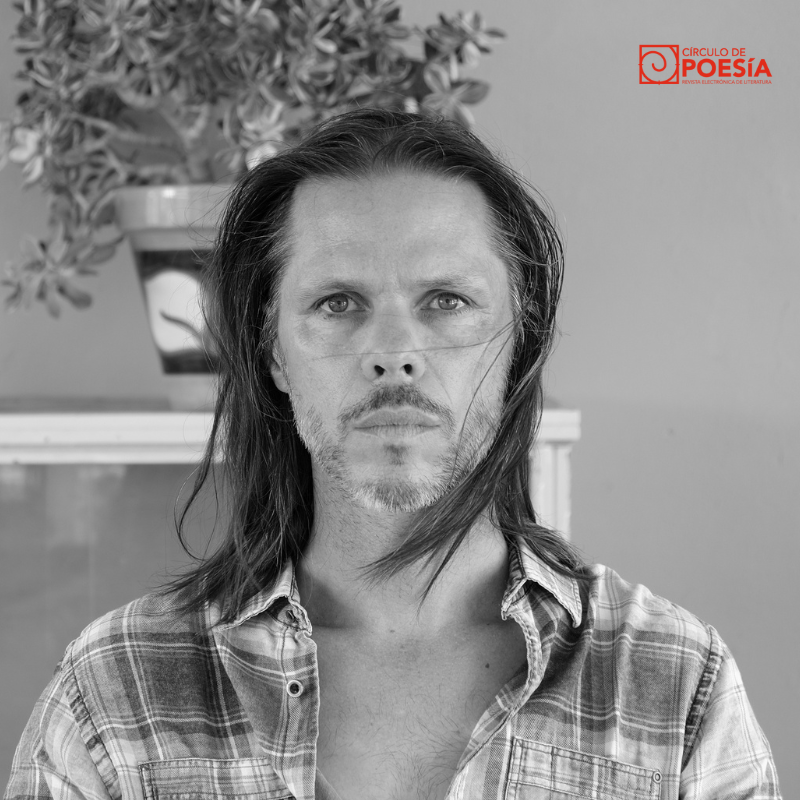
Charles Olsen (Aotearoa Nueva Zelanda, 1969) Artista multifacético, se mueve libremente entre la pintura, escritura, fotografía y trabajos audiovisuales. Ha publicado los poemarios Sr Citizen (Amargord Ediciones, 2011), Antípodas (Huerga y Fierro, 2016) y La rebeldía del sol (Olifante Ediciones de Poesía, 2022). Este último fue resultado de la III Beca Poética SxS Antonio Machado que recibió en 2018. En 2017 recibió la XIII distinción Poetas de Otros Mundos concedida por el Fondo Poético Internacional en reconocimiento a la alta calidad de su obra poética. Sus videopoemas han sido premiados en festivales internacionales y destacados en Moving Poems, Atticus Review y blackmail press. Dirige el juego poético Given Words para el Día Nacional de la Poesía en Nueva Zelanda, que llegó a su 10ª edición en 2025. Sus poemas son incluidos en la antología de poetas neozelandeses inmigrantes, Te Pūrere | The Exodus (Cold Hub Press, 2025), editado por Vaughan Rapatahana y John Gallas. charlesolsen.es
Ni un alma
Las persianas cerradas en el ayuntamiento donde cuelga la bandera. Por la calle de enfrente cojea un gato.
En el sotavento del frontón –un megalito verde– me siento en el banco de madera.
Entre nosotros (gato, pista, bandera) hojas secas crujen por la plaza. Un sosiego, la sombra se inclina y se tensa el cable de electricidad. La campana tañe la media hora.
Pasean por los arbustos –irregulares sobre el umbral agrietado del bungaló– insectos, mariposas, abejas.
A lo lejos escucho la conversación de dos gallos por la mañana, y un tercero grazna como si despertara de una borrachera, réplica hosca del gallo enfermo.
De nuevo el silencio.
La bandera suspendida.
Las hojas, quietas bajo el sol feroz.
Not A Soul
Shutters down at the town hall where the flag hangs. Up the lane in front limps a cat.
In the lee of the fronton court—a green concrete megalith—I sit alone on the wooden bench.
Between us (cat, court, flag) dried leaves crinkle across the square. Stillness, as the shadow leans a little and the electricity wire stretches. The church bell rings the half-hour.
On the shrubs, uneven on the cracked doorstep of the bungalow, alight passing insects, butterflies, bees.
I overhear a morning conversation between two roosters, and a third croaks in as if woken from a drunken stupor, a crook cockerel’s gruff riposte.
Once again silence.
The flag hangs loose.
Dry leaves, still in the fierce sun.
Tierra de juegos
Dunedin, 1975
La voz de mamá llega a donde juego
en la escalera del jardín, Ye banks and braes
o’ bonnie Doon. Los cánticos del domingo,
la euforia del tui que alborota la calle, y los días
en el marae donde, corriendo libre,
escucho la melodía de un lino ondulante.
En el castillo de Larnach, las ortigas pican
mis manos traviesas, o aquella vez que acariciamos temblorosos
pájaros atrapados en plastilina rosa y los salvamos,
o desenterramos conchas de arenas húmedas y
en equilibrio las gaviotas desafían el viento hacia el mar…
Tiene generosidad el huerto,
mi comida: guisantes, la grosella espinosa ácida y
–según mi hermana– bocados de arena seca.
—————
Ye banks and braes o’ bonnie Doon: “Orillas y laderas del bello Doon” del
poeta escocés Robert Burns.
tui: mielero tui, pájaro nativo de Nueva Zelanda.
marae: lugar de encuentro del la comunidad maorí.
Touching Land
Ōtepoti, 1975
Mum’s voice gently drifts out to where I play
on the back laundry step, Ye banks and braes
o’ bonnie Doon. Church hymns on a Sunday,
the tui sings across the street, and days
out at the marae where, running free, I
hear the waiata of shifting flax.
Up at Larnach Castle nettles sting my
small hands, and that time we stroked trembling waxeyes
stuck in pink playdough and dug them free,
or scooped out shells from hard spray-damp sands as,
poised, karoro caught the wind out to sea…
The vege patch manaakitanga has—
my kai are pea pods, tart gooseberry and
(so my sister says) dry handfuls of sand.
Cuando menos lo esperas
La primera me produjo un leve dolor en la memoria. Ocurrió al alcance del oído durante la Lectura Navideña en el Instituto Real sobre Las Maquinas en movimiento.1
La segunda apenas entró. en mi cabeza –la noticia devorada por la noche caótica del Cairo–.
La tercera me dejó molesto. Iba tarde y tuve que desviarme alrededor de Wood Green en la bicicleta para llegar a mi estudio.2
A la cuarta va la vencida. Acababa de salir del gran almacén John Lewis y bajaba por Oxford Street cuando pasaron aullando las patrullas de la policía.3
La quinta dejó un eco más profundo. Al llegar a mi trabajo en Torrejón de Ardoz encontré a mis alumnos apiñados al lado de la radio. Me miraron como si fuera un fantasma. «¿Cómo
diablos has conseguido llegar a salvo?»4
Los días y semanas siguientes continuaron en un extraño desapego.
Salvarse no siempre es salir con vida.
When You Least Expect
The first, at fifteen, produced a dull ache in the memory. It occurred within earshot during the Royal Institution Christmas Lecture, Machines in motion.1
The second hardly registered—the news swallowed up in the chaotic Cairo night.
The third left me annoyed. I was late and had to take a detour around Wood Green on my bicycle to reach my studio.2
Fourth time lucky. I’d just left John Lewis department store and was walking down Oxford Street when police cars came howling past.3
The fifth left a more profound echo. I arrived at work to find my students huddled about the radio. They looked at me as if I were a ghost. “How the hell did you get here?”4
The following days and weeks were strangely detached.
Saving oneself isn’t only about getting out alive.
—————
1 “IRA bomb explodes outside Harrods” 17/12/1983.
2 “Police and shoppers injured in bomb blasts” 10/12/1992.
3 “4 Hurt as 2 I.R.A. Bombs Go Off On Busy London Shopping Street” 16/12/1992.
4 “Madrid Train Attacks” 11/03/2004.
Fragmento de un sueño
Me encuentro con una mujer maorí.
Ella es muy grande
y tiene un corazón igual de grande
y la cara redonda
y ve que estoy triste en mi interior
y me da un abrazo
muy grande
como su corazón
y nos separan
y nos miran
y siento mis ojos húmedos
y su ojo se convierte en un arroyo
que crece y crece
hasta que de pronto cae
como una cascada
sobre su mejilla.
Dream Fragment
I met a big Maori woman
with heart to match
and she looked at me
with her round face
and saw I was sad within
and she gave me a big hug,
as big as her heart.
We separated and looked in each other’s eyes.
I felt my eyes moist
and her eye was glazed in tears
which formed a pool that
grew and grew
until it became a waterfall
cascading over her cheek.
He Kongakonga Moemoeā
Tūtaki au i a tētahi wahine Māori
He wahine nunui
He nui hoki tōna ngākau
Titiro mai ia ki ahau
He kanohi nunui
Kitea ai tōku pōuritanga
He nunui tōna awhiawhi
Pērā anō i tōna ngākau
Wehewehe ana māua
Titiro mai, titiro atu
Waiwai ana ngā kamo
Waiwai ana hoki āna kamo
Rere ana ngā roimata
Me he wairere
Tāheke mai ana i ōna pāpāringa, ē.
—————
Traducción a maorí de Fragmento de un sueño por Ko Te Haeata y Barry Olsen