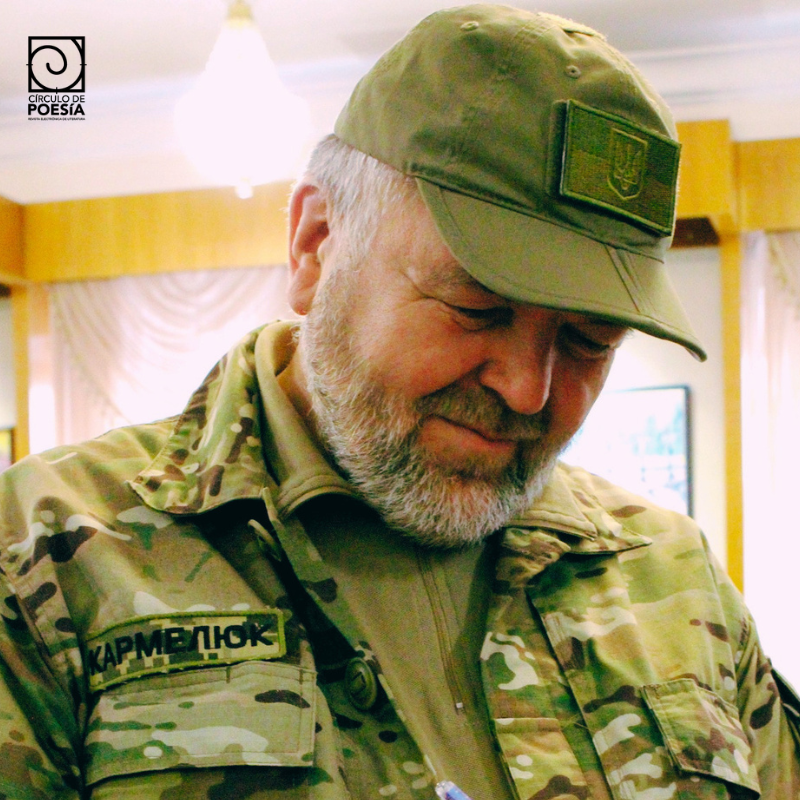
Borys Humenyuk (Ternopil, Ucrania; 1965). Humenyuk es poeta, novelista y reportero. Ha sido nominado al Premio Nacional de Literatura Shevchenco. Es autor de Un medio de defensa (poesía), Lukianivka (novela), La isla (novela),100 Cuentos de guerra, Poemas de guerra y 14 Amigos de la junta. La poesía de Humenyuk no expresa patriotismo. Sus poemas de guerra evidencian las experiencias en el campo de combate: comparten con el lector el dolor y el horror propio, de sus compañeros e, incluso, del enemigo; contienen nombres de personas reales; son intensos, inmediatos, francos y con algo de ironía; expresan el sinsentido que tiene la muerte del soldado, civiles y niños, la destrucción de villas y ciudades. En sí, la poesía de Humenyuk, es la catarsis de un ser humano atrincherado en el escenario hostil de la guerra, sin señalaciones políticas que puedan reclamarla, es una poesía vivencial y testimonial.
Estas gaviotas que sobrevuelan el campo de batalla—
son aves de mal agüero.
No me sorprendería si fuesen cuervos.
Desde hace mucho han comido la carne del soldado.
Poco importa si es la de nuestros héroes
o la de nuestros rivales.
Está de más enojarse con los cuervos
aunque me duela pensar en ellos.
Tampoco me sorprendería si fuesen palomas.
Están acostumbradas a hurgar en la basura humana.
Incluso usan el cabello
extraído de los cráneos sangrientos,
perforados por balas,
para tapizar sus nidos.
Muy bien las comprendo.
No me sorprendería si fueran gorriones.
Sólo desean alimentarse.
Con un alegre canto
picotean los bolsillos y mochilas de los caídos
extrayendo trozos de pan, galletas, azúcar
cualquier otra cosa que puedan robar como trofeo.
A veces, sin querer, picotean los ojos.
Comprendo a los gorriones,
pero a las gaviotas las envidio.
Sobrevuelan en círculo donde yacen los caídos.
Durante el alba y el crepúsculo se ven rosadas —
Procuro decirme que es la luz quien les da tal color
y no la sangre.
Los flamencos se tornan rosados
por ingerir camarones.
Es imposible que las gaviotas adquieran tal color tan rápido
por sólo comer la carne de los caídos.
Para que tal fin se consume
el combate habría de prolongarse más allá de un ciclo solar.
Sobrevuelan un campo de batalla
donde ya nadie recuerda cómo arar,
cómo construir una casa,
cómo sembrar cereales,
cómo dar a luz.
Vuelan en círculos,
se lanzan en picada,
toman su rapiña
y se alejan hacia el mar
más allá de nuestros retenes.
A veces, cuando riñen entre ellos,
dejan caer ante nuestros pies
trozos de carne y huesos humanos.
Es algo hórrido no poder saber
si son las partes de un soldado amigo o las de un rival.
Resulta inquietante
una falange o un lóbulo
cae del cielo
ante tus pies.
A veces pienso
que si reúnes todas esas piezas,
podrías reconstruir a una persona —
amigo o rival—
si tan solo existiera alguien capaz de insuflarle vida.
Gaviotas rosadas —
ojalá jamás las hubiera visto —
son el mayor horror de esta guerra
junto a esos trozos de carne humana
que caen del cielo
y no sabes qué hacer con ellos,
pues no se puede cavar una tumba
tan sólo para un dedo.
These seagulls over the battlefield —
They are so ominous
I can understand ravens
They’ve long fed on the flesh of warriors.
They don’t care whose flesh
Whether that of our heroes or our enemies.
I don’t know if it pays to get mad at ravens
Even if it pains me to think of them
I can also understand pigeons
They’re accustomed to rummaging through human trash
Even when they happen to use hair
They pulled from bloody shot-through skulls
To line their nests with
I understand them
I can understand sparrows
They simply want to eat
With a joyful chirping
They peck from the pockets and backpacks of the dead
Touching the eyes only by chance
Bits and pieces of bread cookies sugar coffee
And anything else the sparrows can take
As trophies
No longer needed by the dead
I understand sparrows
But begrudge the seagulls
They circle the field of the dead
Pink at dawn and dusk —
I try to tell myself that it’s the light that turns them pink
Not blood
Flamingos turn pink
From eating shrimp
Seagulls can’t turn pink so quickly
From eating the flesh of the dead
To achieve such an effect
The war must last over a year
They circle over the battlefield
Where no one remembers how to plow
How to build a home
How to sow grain
How to give birth to children
They circle the field
Dive down
Grab their prey
And they fly to the sea past our checkpoints
They get into scuffles
And sometimes drop their prey
Pieces of human flesh and bone fall to our feet
The awful thing is that we can’t know —
If it’s the flesh of friend or foe
It’s uncanny to see
A human finger
Or an ear
Fall before you
From the sky.
Sometimes I think
That if you collect all the pieces
You might be able to put together a person —
Friend or enemy —
If only we could find someone to bring him back to life
Pink seagulls —
I wish I’d never seen them —
The greatest horror of this war
Along with those pieces of human flesh
That fall from the sky
And you have no idea what to do with them
You can’t dig a grave for just one
Torn off finger.
Cuando limpias tu fusil,
cuando lo limpias una y otra vez,
cuando le untas aceites de olores fuertes
y lo proteges de la lluvia con tu propio cuerpo,
cuando lo envuelves como a un bebé
aunque nunca hayas envuelto uno –
pues apenas tienes diecinueve años, soltero, sin hijos –
el fusil se vuelve tu única familia.
Tú y el fusil se vuelven uno mismo.
Cuando cavas una trinchera tras otra,
cuando cavas con tus manos esta preciosa, esta detestable tierra
de cada dos puñados uno te llega al alma.
Trituras esta tierra con tus dientes.
No tienes y nunca tendrás otra.
Entras en ella como si fuera el vientre de tu madre.
Te sientes abrigado y cómodo.
Jamás te habías sentido tan cerca de alguien.
Tú y la tierra se vuelven uno mismo.
Cuando disparas,
aunque sea de noche y no ves el rostro del enemigo,
pues la noche lo oculta de ti y a ti del él,
y luego los abraza como a sus propios hijos,
llevas el olor a pólvora.
Tus manos, tu rostro, tu cabello, tu ropa, tus botas –
por mucho que los laves – huelen a pólvora,
huelen a guerra.
Tú hueles a guerra.
Tú y la guerra se vuelven uno mismo.
When you clean your weapon
When time and again, you clean your weapon
When you rub strong-smelling oils into your weapon
And shield it from the rain with your own body
When you swaddle it like a baby
Even though you’ve never swaddled a baby before –
You’re only nineteen, no babe, no wife –
The weapon becomes your only kin
You and the weapon are one.
When you dig trench after trench
When you dig this precious this hateful earth by handfuls
Every other handful reaches your soul
You grind this earth between your teeth
You don’t, you never will have another
You climb into the earth like into your mother’s womb
You are warm and snug
You’ve never felt this close to anyone before
You and earth are one.
When you shoot
Even when it’s at night and you don’t see the enemy’s face
Even when night hides the enemy from you and you from the enemy
And embraces each of you as her own
You smell like gunpowder
Your hands, face, hair, clothing, shoes –
No matter how much you wash them – smell of gunpowder
They smell of war
You smell of war
You and war are one.
Ni un solo poema en cuarenta días.
La poesía bajó al sepulcro
el 23 de noviembre, cuando Andriy Yurga,
combatiente del batallón del "OUN",
cayó en la batalla de Pisky.
Originario de Lviv. Lo llamaban "David".
La poesía oscureció,
guardó de luto por cuarenta días,
luego se cubrió de tierra
y después de ceniza.
Por cuarenta días la poesía se atrincheró
apretando los dientes y disparando en silencio.
La poesía no quería hablar con nadie.
¿De qué podría hablar?
¿De la muerte?
En esos días la poesía fue testigo de muchas muertes.
La poesía vio cómo morían los árboles:
Esos que corrían a través de los campos minados del otoño
y nunca lograron llegar al invierno.
Vio cómo morían animales:
gatos y perros
arrastrando sus tripas por las calles
como si fuera algo habitual.
La poesía no sabía qué hacer:
si apiadarse y ayudarlos a morir,
o apiadarse y dejarlos vivir.
Vio cómo las casas morían.
La de ellos,
la tuya.
¿Era tu casa aquella,
la de la vuelta de la esquina?
Hace un año, era una casa cualquiera:
un jardín en el frente,
una huerta en el patio
con manzanos, ciruelos, perales,
un nogal al centro
y las personas que solían habitarla.
Cuando entró la primera bala
la casa estaba confundida
jadeaba en silencio
lloraba en silencio:
la bala había herido una pared.
Luego llegaron otras balas.
La casa no fue capaz predecir tales llegadas
y no tuvo tiempo de protegerse:
cubrirse con las manos
esconderse en el ático o
en el sótano.
Las balas hirieron las paredes,
rompieron ventanas,
volaron por la cocina, la sala,
la habitación de los niños,
en busca de personas.
Las balas siempre andan en busca de personas.
Las personas son la razón de ser de una casa.
Luego cayó un obús de mortero.
En otoño, la casa disfrutaba del sonido
que hacían las nueces y manzanas
al caer sobre techo.
Pero ahora había sido un obús.
Luego un lanzacohetes envió un misil.
La casa saltó como lo haría una niña
sobre una fogata en el solsticio de verano.
Quedó suspendida en el aire por un momento
y luego descendió lentamente.
Le fue imposible mantenerse erguida.
Las paredes, el piso, los muebles,
los juguetes, los utensilios de cocina, el reloj de pie.
Todo fue mordido por la guerra,
lamido por el fuego.
La poesía vio cómo las personas morían.
Se puso casquillos de balas en los oídos.
Habría preferido quedare ciega
que ver cadáveres todos los días.
La poesía es un atajo al cielo.
La poesía contempla el vacío.
Y cuando caes
te recuerda el camino de regreso.
La poesía ha ido a lugares
donde no hay lugar para la poesía.
La poesía lo vio todo.
La poesía lo vio todo.
Not a poem in forty days
Poetry went to the grave
When on November 23rd
Andriy Yurga, a fighter of the “OUN” battalion
Died in battle at Pisky
He came from Lviv, nickname “Davyd.”
Poetry turned black
Wore mourning clothes for forty days
Then it was covered with earth
Then with ash
Forty days poetry sat in the trenches
Clenching its teeth shotting back in silence
Poetry didn’t want to talk anyone
What is there to talk about?
Death?
During those forty days poetry saw many deaths.
Poetry saw trees die.
Those that ran through the minefields of fall
And never made it to winter.
Poetry saw animals die.
Wounded cats and dogs
Dragging their spilling guts down the streets
As if this were something ordinary
Poetry didn’t know what to do:
Take a pity and help them die, or
Take a pity and let them live.
Poetry saw houses die.
Their houses,
Your house.
Was that your house
Over there, around the corner?
A year ago an ordinary house
With flowers in the front
And a garden in the back,
With apple trees, plum trees, pear trees,
A walnut tree in the garden
With the people who used to
Live there.
When the first bullet came
The house didn’t understand
It gasped quietly
And wept quietly:
The bullet wounded a wall.
Other bullets came
The house could never guess when they would arrive
It couldn’t get ready for them
Cover itself with hands
Hide in the attic or
In the basement.
The bullets made holes in the walls
Broke the windows
They flew into the house
The kitchen, the living room,
The kids room.
Looking for people.
Bullets always look for people.
People are the reason for a house.
Then came the mortar shell
In autumn, the house used to like the sound
Of walnuts and apples
Hitting the roof.
Now the shell hit the roof.
Then came a rocket from the rocket launcher.
The house leapt up like a girl
Jumping over a fire at the summer solstice
It hung in the air for a moment
Then landed slowly
But it could no longer stand up straight.
Walls, floors, furniture,
Kids toys, kitchenware, grandfather clock,
All of it bitten by war,
Licked by fire.
Poetry saw people die.
Poetry put spent bullet shells in its ear.
Poetry would rather go blind
Than see corpses every day.
Poetry is the shortcut the heaven.
Poetry sees into the void.
When you fall
It lets you remember your way back.
Poetry went places
Where there isn’t place for poetry.
Poetry witnessed it all.
Poetry witnessed it all.
Testamento
Hoy volvemos a cavar la tierra,
esta tierra odiada de Donetsk,
esta tierra rancia y petrificada.
Nos apretamos contra su pecho,
nos ocultamos en su vientre,
aún vivos.
Nos escondemos tras ella,
nos sentamos en silencio en su regazo
como niños pequeños detrás de su madre.
Escuchamos el latido de su corazón,
su aliento cansado.
Nos sentimos abrigados, cómodos,
aún vivos.
Mañana moriremos.
Quizá algunos de nosotros.
Quizá todos.
No nos arranquen de la tierra.
No nos separen de nuestra madre.
Dejen nuestros restos en campo,
no intenten remendarnos.
Y – suplicamos - no levanten cruces,
ni monumentos, ni lápidas de piedra muda.
No las necesitamos
pues no son para nosotros.
Las erigen para su propia satisfacción.
No tallen nuestros nombres.
Solo recuerden:
en este campo,
en esta tierra,
yacen soldados ucranianos.
Y eso basta.
No pedimos funerales.
Conocemos bien nuestro lugar.
Solo cúbrannos con tierra
y sigan adelante.
Sería hermoso que un día en este campo
espigas de centeno se mecieran con el viento,
que una alondra sobrevolara
el cielo, el cielo infinito.
¿Pueden imaginar el grano que daría
el campo donde yacen guerreros?
Para recordarnos, coman el grano de este campo
donde entregamos la vida.
Sería hermoso que allí hubiera praderas
y muchas flores
y una abeja bajo cada flor;
y amantes que acudan al atardecer
a tejer coronas
a se amen hasta el alba;
y que durante el día, nuevos padres
traigan a sus hijos.
No impidan que los niños vengan a nosotros.
Pero eso será mañana.
Hoy seguimos cavando esta tierra,
esta amada tierra ucraniana,
esta tierra dulce y tierna.
Y en su piel escribimos
a un solo puño con la pala del soldado
el último poema ucraniano
de los últimos poetas
que aún respiran.
A Testament
Today we are digging the earth again
This hateful Donetsk earth
This stale, petrified earth
We press ourselves into it
We hide in it
Still alive
We hide behind it
Sit silently in it
Like little children behind their mother’s back
We hear its heart beating
Its weary breath
We are warm and comfortable
Still alive
Tomorrow we will die
Maybe some of us
Maybe all of us
Don’t take us from the earth
Don’t tear us away from our mother
Don’t gather our remains from the field
Don’t try to put us back together again
And — we beg you — don’t erect crosses
Monuments or memorial slabs
We don’t need them
Because it isn’t for us —
You erect these monuments for yourselves.
Don’t engrave our names,
Simply remember:
On this field
In this earth
Ukrainian soldiers lie
And — that is all.
We don’t need funerals
We know where our place is
Simply cover us with earth
And move on
It would be nice if there was a field
Where rye is swaying
A lark flies overhead
And — the sky
The endless sky —
Can you imagine the grain a field
Where warriors are lying will yield?
To remember us, eat the grain from the field
Where we laid down our lives
It would be good if there were meadows there
And many flowers
And a bee under each flower
And lovers who come in the evening
To weave wreaths
To make love till dawn
And during the day, let new parents
Bring their young children
Don’t keep children from coming to us
But this will be tomorrow
Today we are still digging the earth
This cherished Ukrainian earth
This sweet, gentle earth
And with a soldier’s spade we write as one
On its body
The last Ukrainian poem of the last poets
Left alive